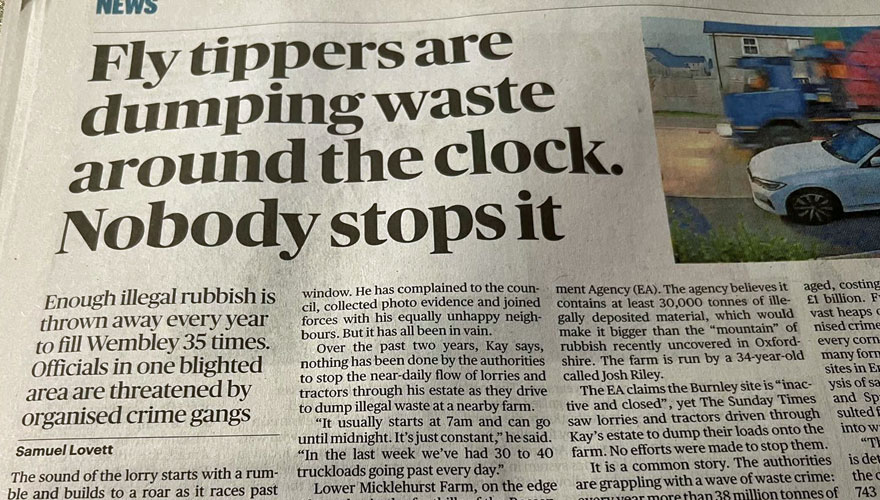
A recent Sunday Times investigation highlights the alarming scale of illegal waste activity..
An estimated 38 million tonnes of waste — enough to fill Wembley Stadium 35 times — is believed to be illegally managed each year, costing taxpayers around £1 billion.
This ranges from roadside fly-tipping to vast illegal waste sites run by organised crime groups, often described as operating in a way similar to drug trafficking due to the profits involved.
Analysis using satellite imagery by Air and Space Evidence, cited during a House of Lords inquiry, estimates there are around 5,900 illegal waste sites across England.
In contrast, the Environment Agency (EA) shut down 743 sites in 2024–25, while some investigations have remained open for more than a decade.
If the statistics are to be believed, 743 sites represents a clean up rate of 12.5% and that is after the damage has been done.
How Waste Crime Works
Legitimate waste companies can charge up to £450 per tonne for non-recyclable commercial waste due to transport costs, landfill gate fees, and landfill tax.
Criminal operators undercut this by offering suspiciously “competitive” rates — often only slightly cheaper — to avoid raising alarm.
According to the Environmental Services Association (ESA), a single illegally dumped 28-tonne lorry-load can allow criminals to avoid more than £4,000 in taxes and fees.
Businesses may unknowingly hand waste to illegitimate operators, who then process it crudely and dump it on private land, sometimes without the landowner’s knowledge.
In other cases, landowners may be complicit.
These activities can generate tens of thousands of pounds a week and have even been linked to intimidation and threats against council and EA staff.
Enforcement Challenges
Efforts to tackle waste crime are hampered by limited resources and inconsistent intelligence sharing between councils, police, and the EA.
Although a joint waste crime unit was set up to improve coordination, critics argue it has been uneven in effectiveness.
The EA has acknowledged the issue and says it is increasing staffing to strengthen enforcement.
Why This Matters for Businesses
For businesses producing general or hazardous waste, the message is clear:
using licensed, compliant waste carriers protects you from legal risk, supports recycling, and helps stop organised crime.
Choosing legitimate waste collection and transport services ensures waste is handled responsibly, lawfully, and in line with England’s environmental regulations — safeguarding communities, land, and the environment for the long term.